Showing posts with label classical liberalism. Show all posts

Friday, July 20, 2012

About Locke Smith


(The following is a discussion post from a past assignment for a 300 level government class)

John Locke understood all property as originally being held in common from God, and based the idea of just property acquisition on the process of mixing one’s own labor with a previously common and abundant resource. Through adding labor to a resource it becomes legitimately owned private property. For example, a person would be able to make property claim on a parcel of land if he is able to make use of it through farming, or he could also use the previously common trees and carve out canoes for use or sale. Someone, however, cannot legitimately make a claim to a huge geographic region of uninhibited land—he (or she) can pretend to—but does not possess the actual property right because they would not be able to make use of the vast space; it would be an empty declaration. The act of original appropriation is referred to as the homesteading principle. Locke argued that a field that is tended by human labor to harvest food is worth more than a field left untouched because the productivity of the land has been improved, adding value to the overall material standard of living of those who work or purchase food that would otherwise be more scarce in a state of nature. Through this process money had organically emerged by mutual consent as a means of exchanging perishable goods for non-perishable goods; it also allowed for the more efficient transactions between all goods, which in turn created an environment for humans to think and plan more for the long-term. In a way it is following Genesis 1:28 in subduing the earth by the ability to far more easily invest in long-term capital projects that otherwise would not be possible, or, at the minimum, would prove very difficult to accomplish on such a complex, large scale.

I find the Lockean concept of private property and its acquisition potential to be of critical importance for a peaceful, civilized, and free society. Two particular principles discussed by me earlier that I am familiar with have been developed from Lockean thought: the principles of self-ownership and non-aggression. In other words, "every man has a Property in his own Person” (Strauss, 1997, p.486) and by mixing previously common property with labor it becomes legitimate private property by the individual doing the “mixing.” When any outsider acts with unjust use force (aggresses) or makes a threat against that person or their property, it is to be considered an act of war (Strauss, 1997, 479).  From this reasoning it can be deduced that in nature individuals have God-given rights of life, liberty, and property. These general principles are compatible with Scripture and necessary for voluntary peaceful human civilization.

The rejection of private property rights implies that some greater authority other than one’s self is at play. Many would say that everything is Gods property, which is true, but the rejection of private property rights for individuals on earth logically implies that someone or some group of fellow humans must have rights over other persons and their justly acquired property. I was reminded of an article about a secret agreement that revolutionized China: the secret agreement was to illegally subdivide the previously collectivized property of the village of Xiaogang into family units, and the families would be able to keep any surplus they created rather than be forced to share it. The result of this seriously life threatening agreement was an increased harvest “more than the previous five years combined” (Kestenbaum & Goldstein, 2012). The rejection for private property can naturally include people, too, if it is for the “general will” or “common good.” In the same article, a farmer asked the communist party officials if he even owned the teeth in his mouth. The party replied “No. Your teeth belong to the collective” (Kestenbaum & Goldstein, 2012). This is only one example of the disastrous effects of the rejection of property rights for modern human civilization. Today there is both theoretical and empirical evidence supporting property rights. The latter is found throughout human history but especially in the 20th century like the example above. The former is supported from many valuable angles too, but the most devastating is the problem of rational economic calculation under a socialist commonwealth, otherwise known as the economic calculation problem (ECP) (Horwitz, 1998, p.430). 

Adam Smith did essentially advance an argument that is similar to the Lockean perspective but he focuses more on moral and economic thought. He seemed to view man as social with natural sentiments that are both self-interested and compassionate for those being oppressed and treated unjustly (Strauss, 1997, p.644). In general contrast to Hobbes and Rousseau, Locke and Smith saw that man in general has both self-interested and sympathetic passions. Both saw a form of limited government with individual freedoms as being most conducive to a peaceful, prosperous civil society. Hobbes and Rousseau, on the other hand, favored certain governments that may appear differently and have opposing foundations from each other, but both placed no limitations of the “absolute sovereign” or the “general will” over the individual.

Like most classical economists, Smith generally held to a labor theory of value. It shouldn’t be denied that labor does indeed play the primary role in the just acquisition of property. The implications of this theory for early laissez-faire economic analysis are fairly negligible, but when alternative systems of economic organization are planned on the basis of this theory, such as Marxism, there are significant problems. Labor cannot be considered as the lowest common denominator from which to rationally calculate and allocate scarce resources in a complex economy with the division of labor (Mises, 1981, p. 101); this is the foundation of the economic calculation problem. Without relative money prices derived from the aggregate decisions of consumers and suppliers in a market economy based on private ownership of the means of production, it is impossible for rational economic calculation; prices are packed with and relay crucial information to everyone about the relative scarcity and demand. Trying to find the relative ratios in labor from a doctor to a janitor and the millions of other occupations is impossible even with a super computer because it cannot account for value that is subjective.

Smith also recognized and put extra emphasis on the relationship between intention and consequences, specifically the convergences and divergences between good intentions and socially desirable outcomes. Paradoxically, when people pursue their self-interest under generally accepted norms of behavior with institutions that legitimately enforce and punish those who resort to the use of force or fraud, they grow wealthier as a whole. “It is not from the benevolence of the butcher, the brewer, or the baker, that we can expect our dinner, but from their regard to their own interest” (Smith, 1776, p19). Private ownership of the means of production under the social structure of division of labor was to him, and many today, “the system of natural liberty.”


References:

Cahn, S. M.  (2002). Classics of moral and political philosophy.  New York: Oxford University Press.  ISBN: 0-19-514091-5. 

Horwitz, S. (1998). Monetary Calculation and Mises's Critique of Planning. History Of Political Economy30(3), 427-450.

Kestenbaum, D. & Goldstein, J. (2012, January). The Secret Document That Transformed China. Retrieved on June 20, 2012, fromhttp://www.npr.org/blogs/money/2012/01/20/145360447/the-secret-document-that-transformed-china

Locke, J. (1764). Two Treatises of Government, ed. Thomas Hollis (London: A. Millar et al., 1764). Accessed from http://oll.libertyfund.org/title/222 on 2012-06-04

Mises, Ludwig von. (1981) Socialism: An Economic and Sociological Analysis. J. Kahane, trans. 1981. Library of Economics and Liberty. Retrieved June 21, 2012 from the World Wide Web: http://www.econlib.org/library/Mises/msS.htm

Smith, Adam. An Inquiry into the Nature and Causes of the Wealth of Nations. Edwin Cannan, ed. 1904. Library of Economics and Liberty. Retrieved June 20, 2012 from the World Wide Web: http://www.econlib.org/library/Smith/smWN.html

Strauss, L., & Cropsey J. (Eds.).  (1997). History of political philosophy (3rd Ed.).  Chicago: University of Chicago Press. ISBN: 0-226-77710-3.


Friday, July 15, 2011

Liberalism- A Repository of Classical Liberal Quotes


What is true liberalism and how does it differ from what is called "liberal" in America today?


Note, this post may occasionally be updated.


Also see part 1. Liberalism- The Terminological Theft- Classical liberal quotes


Liberals believe that the main institutions of society can function in entire independence of the state:
"Liberalism ... is based on the conception of civil society as by and large self-regulating when its members are free to act within the very wide bounds of their individual rights. Among these, the right to private property, including freedom of contract and exchange and the free disposition of one's own labor, is given a high priority. Historically, liberalism has manifested a hostility to state action, which, it insists, should be reduced to a minimum."
Classical Liberalism and the Austrian School by Ralph Raico


"The liberal vision offers an entirely different solution. Many western countries satisfy at this stage much more closely the social democrat model than the liberal vision...It differs fundamentally from the other three [socialism, social democratic, and conservative] positions by a severe constitutional limitation
on the range of admissible government activities. It also involves a much stricter constitutional anchoring of property rights...The constitutional emphasis of the liberal position implies, of course, a dominant reliance on markets and market prices as a social coordination mechanism.”
Economic Analysis and Political Ideology by Karl Brunner


"But libertarianism, however weak its influence today, is a much greater long-term threat to the left than is any form of conservatism, and the leftist intellectuals sense this even if they can’t articulate why. Leftism, whether they know it or not, is a distorted permutation of the classical liberal tradition. The statist left did their deal with the devil – the nation-state, centralized authority of the most rapacious kind – supposedly with the goal of expediting the liberation of the common man and leveling the playing field. More than a century since the progressives and socialists twisted liberalism into an anti-liberty, pro-state ideology, they see that they have made a huge mess of the world, that, as they themselves complain, social inequality persists, corporatism flourishes, and wars rage on. As the chief political architects of the 20th century in the West, they have no one to blame but themselves, and so they target us – the true liberals, the ones who never let go of authentic liberal idealism, love of the individual dignity and rights of every man, woman and child, regardless of nationality or class, and hatred of state violence and coercive authoritarianism in all its forms."
Why the Left Fears Libertarianism by Anthony Gregory


"But under Obama we have seen the reinvigoration of the progressive left – perhaps the worst element of the left. It distrusts social authority, but not as much as the radical left, and not when that social authority – corporations, unions, even religious institutions – can be co-opted for the purpose of advancing the state. The progressives truly are the tradition that destroyed liberalism in America, erected a national police state, embraced corporatism in the disingenuous name of egalitarianism, and turned the U.S. into a global empire."
What About the 'Real' Left? by Anthony Gregory
"The Ron Paul campaign proved that classical liberalism is on the side of youth. Failing to provide it for the generations to come would be to put out the light completely."
Quo vadis, domine? by Terry Hulsey


"No one quite knows what to do about Congressman Ron Paul, Republican candidate for president.He refuses to play by the rules. He's a bigger supporter of the free market than anyone in Congress, but he's also the most consistent opponent of war. (That the conjunction of these positions — which amount to classical liberalism in a nutshell — should actually seem surprising or odd goes to show how perverse our political system has become.)"
The Revolutionary Candidate by Thomas E. Woods


"The classical liberals, from Hume and Smith through to Hayek, are concerned with the construction of a social order in which individual liberty can be maximised; social order and liberty do indeed develop conterminously. Principles and processes emerge (almost accidentally) from individual action but the individual is never abstracted from social processes, whether as a rights-bearer or, even, as a utility-bearer."
On Classical Liberalism and Libertarianism by Norman Barry


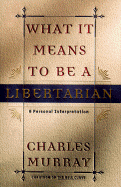
"The correct word for my view of the world is liberal. "Liberal" is the simplest anglicization of the Latin liber, and freedom is what classical liberalism is all about. The writers of the nineteenth century who expounded on this view were called liberals. In Continental Europe they still are . . . . But the words mean what people think they mean, and in the United States the unmodified term liberal now refers to the politics of an expansive government and the welfare state. The contemporary alternative is libertarian . . ."
What it means to be a libertarian: a personal interpretation By Charles Murray


Using the term liberalism to refer to the ideas of liberty, Ortega declared:
"Liberalism and democracy happen to be two things which begin by having nothing to do with each other, and end by having, so far as tendencies are concerned, meanings that are mutually antagonistic. 
Democracy and liberalism are two answers to two completely different questions.  


Democracy answers this question — “who ought to exercise the public power?” The answer it gives is — “the exercise of public power belongs to the citizens as a body.” 


Liberalism, on the other hand, answers this other question — “regardless of who exercises the public  power, what should its limits be?” The answer it gives is — “whether the public power is exercised by  an autocrat or by the people, it cannot be absolute; the individual has rights which are over and above  any interference by the state.” Ortega y Gasset

"Constitutional liberalism ... is not about procedures for selecting government but, rather, government’s goals. It refers to the tradition, deep in Western history, that seeks to protect an individual’s autonomy and dignity against coercion, whatever the source — state, church, or society. The term marries two closely connected ideas. It is liberal because it draws on the philosophical strain, beginning with the Greeks and Romans, that emphasizes individual liberty. It is constitutional because it places the rule of law at the center of politics"


... Democracy is flourishing; liberty is not. 


— The Future of Freedom: Illiberal Democracy at Home and Abroad by Fareed Zakaria


"[A]t the heart of classical liberalism is a prescription: Nurture voluntary associations. Limit the size, and more importantly, the scope of government. So long as the state provides a basic rule of law that steers people away from destructive or parasitic ways of life and in the direction of productive ways of life, society runs itself. If you want people to flourish, let them run their own lives." 
Civil Society and Government by Nancy L. Rosenblum and Robert C. Post


In review of the book, The Decline of American Liberalism, the following has been said,
“For [Ekirch], liberalism means the emergence of man over the State; it conveys a sense of the dignity and self-determination of the individual. The intellectuals of the present time have pre-empted the word ‘liberalism’ and corrupted it to mean the use of the State’s power to accomplish ‘social ends.’ But as this book makes clear, the true liberal—whether he calls himself a conservative, a libertarian, or an individualist—is the man who sets his heart and mind on the eternal but elusive goal of liberty.” 
Sheldon Richmond, Editor, The Freeman


“In this stimulating book Professor Ekirch undertakes to show that American liberalism has been in steady decline since the founding of our republic. This classical liberalism has as its central doctrines ‘the concept of limited representative government and the widest possible freedom for the individual—both intellectually and economically.’ . . . In the space of a hundred and fifty years, ‘liberalism’ has practically reversed its meaning and is now used to sanction a statism potentially more absolute than anything seen in the past. But that [Ekirch] has given the true history of a decline seems to me indubitable.
Richard M. Weaver, Professor of English, University of Chicago (in the Mississippi Valley Historical Review)


“How is it possible that one hundred and fifty years ago liberalism meant the advocacy of freedom and economiclaissez faire and that today it means the creed of totalitarian statism? Many people are aware of this total reversal. But few, especially today’s liberals, know, or care to know, how or why it came about. In an engrossing book, distinguished for its scholarship, Professor Ekirch provides the evidence for understanding and explaining how two mutually antagonistic creeds share the name of liberalism and how one led to the other. v surveys the rise and demise of liberal ideology and institutions in America.”
Robert Hessen, Senior Fellow Emeritus, Hoover Institution, Stanford University


“The book takes the form of an intellectual history of the United States. . . . Ekirch’s story is one of moral and political retrogression. . . . It shows, for one thing, that the seeds of liberal self-defeat began with confusions embedded in the Founders’ own ideology, and shows how these confusions ramified through history. The book also offers a usefully critical perspective on the Progressives, . . emphasizing the continuities between American Progressivism and European anti-liberalism, both fascist and socialist. And Ekirch’s discussion of the confusions of Progressive discourse on war and imperialism around the time of World War I is both valuable and topically relevant. There are probably dissertations waiting to be written on the parallels between the wartime discourse of the Progressives and that of our contemporary “liberal hawks”; chapter 12 of Decline might not be a bad place to begin research.”
Reason Papers


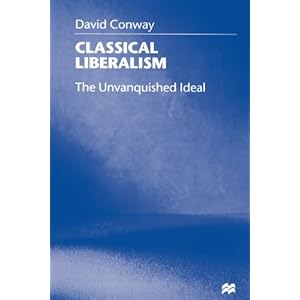
"After falling into almost complete intellectual disrepute towards the end of the nineteenth century, classical liberalism was rescued from oblivion and revived in the twentieth century by such notable thinkers as Ludwig von Mises and Friedrich Hayek." 
David Conway, Classical Liberalism: The Unvanquished Ideal


Ludwig von Mises


Liberalism: In the Classical Tradition by Ludwig von Mises


"Rhetorical bombast, music and song resound, banners wave, flowers and colors serve as symbols, and the leaders seek to attach their followers to their own person. Liberalism has nothing to do with all this. It has no party flower and no party color, no party song and no party idols, no symbols and no slogans. It has the substance and the arguments. These must lead it to victory." 


"All modern political parties and all modern party ideologies originated as a reaction on the part of special group interests fighting for a privileged status against liberalism."


"The program of liberalism, therefore, if condensed into a single word, would have to read: property, that is, private ownership of the means of production. . . . All the other demands of liberalism result from this fundamental demand."


"Liberalism limits its concern entirely and exclusively to earthly ife and earthly endeavor. The kingdom of religion, on the other hand, is not of this world. Thus, liberalism and religion could both exist side by side without their spheres touching. . . . Liberalism proclaims tolerance for every religious faith and every metaphysical belief, not out of indifference for these higher things, but from the conviction that the assurance of peace within society must take precedence over everything and everyone."


"The goal of the domestic policy of liberalism is the same as that of its foreign policy: peace. It aims at peaceful cooperation just as much between nations as within each nation."


"There can be no more grievous misunderstanding of the meaning and nature of liberalism than to think that it would be possible to secure the victory of liberal ideas by resorting to the methods employed today by the other political parties."

Nation, State, and Economy by Ludwig von Mises

"Liberalism, which demands full freedom of the economy, seeks to dissolve the difficulties that the diversity of political arrangements pits against the development of trade by separating the economy from the state. It strives for the greatest possible unification of law, in the last analysis for world unity of law. But it does not believe that to reach this goal, great empires or even a world empire must be created."


"Liberalism knows no conquests, no annexations; just as it is indifferent towards the state itself, so the problem of the size of the state is unimportant to it. It forces no one against his will into the structure of the state. Whoever wants to emigrate is not held back. When a part of the people of the state wants to drop out of the union, liberalism does not hinder it from doing so. Colonies that want to become independent need only do so. The nation as an organic entity can be neither increased nor reduced by changes in states; the world as a whole can neither win nor lose from them."


Socialism: An economic and sociological analysis by Ludwig von Mises 


"Liberalism champions private property in the means of production because it expects a higher standard of living from such an economic organization, not because it wishes to help the owners." 


"The only task of the strictly Liberal state is to secure life and property against attacks both from external and internal foes."


"That Liberalism aims at the protection of property and that it rejects war are two expressions of one and the same principle."


"[Classical] Liberalism and capitalism address themselves to the cool, well-balanced mind. They proceed by strict logic, eliminating any appeal to the emotions. Socialism, on the contrary, works on the emotions, tries to violate logical considerations by rousing a sense of personal interest and to stifle the voice of reason by awakening primitive instincts."


The Causes of the Economic Crisis, and Other Essays Before and After the Great Depression by Ludwig von Mises


"Inflationism, however, is not an isolated phenomenon. It is only one piece in the total framework of politico-economic and socio-philosophical ideas of our time. Just as the sound money policy of gold standard advocates went hand in hand with liberalism, free trade, capitalism and peace, so is inflationism part and parcel of imperialism, militarism, protectionism, statism and socialism.


Human Action by Ludwig von Mises


"First, I employ the term "liberal" in the sense attached to it every-where in the nineteenth century and still today in the countries of continental Europe. This usage is imperative because there is simply no other term available to signify the great political and intellectual movement that substituted free enterprise and the market economy for the precapitalistic methods of production; constitutional representative government for the absolutism of kings or oligarchies; and freedom of all individuals from slavery, serfdom, and other forms of bondage."


Epistemological Problems of Economics by Ludwig von Mises


"To the man who adopts the scientific method in reflecting upon the problems of human action, liberalism must appear as the only policy that can lead to lasting well-being for himself, his friends, and his loved ones, and, indeed, for all others as well."


Wednesday, September 29, 2010

Norwegian Progress party talks to ReasonTV


In a country of exceptionally high rates of personal taxation and home to one of the world's most generous welfare states, Norway's Progress Party, which describes itself as a "classical liberal" or "conservative liberal" organization committed to "personal freedom," is something of an anomaly. But it is an increasingly powerful anomaly, now ranking as the country's second biggest political party.

In August, Progress Party leader Siv Jensen sat down with Reason senior editor Michael C. Moynihan and explained that Norwegians are growing tired of "regulation, bureaucracy, and high taxes" and why the Scandinavian health care model is bad for America—and Scandinavia.

Note: The Progress Party in Norway is not to be confused with what in America is referred to as "progressive".  In most aspects, they directly contrast each other in political ideology. The Progress Party in Norway is truly progressive while progressives in America are regressive.